April 29, 2013

Slenderman

This is a slight shift from the rules, as this particular spook is confirmed to be fictional, but his lore is popular enough that studying his origins is quite interesting, and not everyone knows about him yet! I give you, Slenderman!


The Slender Man (also known as Slender Man or Slenderman) is a fictional character that was created by user Victor Surge on the Something Awful forums in 2009. He is depicted as a thin, unnaturally tall man with a blank and featureless pure white, bald face, and wearing a black suit with tie. He is claimed to be able to increase his height at will, and stretch his arms to any length, as well as produce long, writhing tentacles from his back. Slender Man is said to stalk, kidnap, or traumatize people, young children in particular. He lurks most often in forests and dark playgrounds, and is able to teleport at will, though the distance he is able to teleport varies. He is one of the most popular creatures on the website creepypasta.com.


Slenderman was created for a contest launched on the Something Awful forums , the goal being to edit photographs to contain supernatural entities. On June 10, a forum poster with the user name "Victor Surge" uploaded two black and white images of groups of children, adding a tall, thin spectral figure wearing a black suit hidden slightly in the backrounds, peeking out just enough to unnerve the viewer, and depicted as heading for the children. Surge added bits of text to the photos, something no one in the contest had yet done, supposedly from witnesses, describing the abductions of the groups of children, and giving the character the name, "The Slender Man", which helped the popularity of his submission surge:

    "We didn’t want to go, we didn’t want to kill them, but its persistent silence and outstretched arms horrified and comforted us at the same time… 1983, photographer unknown, presumed dead.

    One of two recovered photographs from the Stirling City Library blaze. Notable for being taken the day which fourteen children vanished and for what is referred to as “The Slender Man”. Deformities cited as film defects by officials. Fire at library occurred one week later. Actual photograph confiscated as evidence. 1986, photographer: Mary Thomas, missing since June 13th, 1986."


Slenderman has soon become an international folklore, spawning fanart, doctored photos, 'real life accounts' and even a couple video games and a mock-umentry of some teenagers who run afoul of him. As of August, 2012, the video game has been downloaded over 2 million times, and was given a couple sequels, including an app game for phones. His popularity has grown enough that people insist he is real, and have either witnessed him themselves, or know someone who has.


The fact that Slenderman is proven to be a myth, and made purely for a contest, and yet easily terrifies people, and garners several claims to truth, relates back to telling ghost stories and urban legends around campfires and flashlights in the living room purely to scare each other.

Some people claim he is just a myth, others claim that his 'creator' used one of his own personal experiences with the entity as his inspiration for the submission he gave. Whatever the answer is, perhaps you'll think twice about taking a shortcut through those woods at night?

And as always, if any of you have tales or experiences of your own involving any of these beasties, please post said stories on the monsters' respective pages!!

March 3, 2013

Banshee


Yet another creature from the lovely country of Ireland, I give you, the Banshee!


The banshee is another well known creature of folklore, though she is often mistaken as a malevolent spirit.

According to the tales, a banshee is a fey woman who begins to wail if someone is about to die. In later versions, the banshee might appear before the death and warn the family by wailing, in attempts to save them. When several banshees appeared at once, it signaled the death of someone great or holy. The tales didn't always portray her as a fey. She is often thought of as a ghost, usually either a murdered woman, or a mother who died during childbirth. In Scottish Gaelic mythology she is known as the bean sìth or bean-nighe and is seen washing the blood-stained clothes or armour of those marked for death. Alleged tales of banshees appearing have been reported as late as 1948, and as far back as far as 1380, with the publication of the Cathreim Thoirdhealbhaigh (Triumps of Torlough) by Seean mac Craith.

The story of the banshee began as a fairy woman keening at the death of important people, and in later stories, the appearance of the banshee could predict death. Banshees are said to wail only for particular Irish families, though which families made it onto this list vary depending on who is telling the story. Most, though not all, surnames associated with banshees have the Ó or Mac prefix, such as O'Malley, or MacCormack.


The banshee can appear in a variety of forms, though most often she appears as an ugly, frightening hag. However, she can also appear as a stunningly beautiful woman, and in some tales, the figure who first appears to be a "banshee" is later revealed to be the Irish battle goddess, the Morrígan. Banshees are often described as dressed in white or grey, having long, pale hair which they brush with a silver comb. This comb detail is also related to the centuries-old traditional romantic Irish story that, if you ever see a comb lying on the ground in Ireland, you must never pick it up, or the banshees, having placed it there to lure unsuspecting humans, will spirit such gullible humans away.

Although not always seen, her mourning call is heard easily across the land, normally at night when someone is about to die. In 1437, King James I of Scotland was approached by an Irish seer who was later identified as a banshee who foretold his murder at the instigation of the Earl of Atholl. Banshees are usually only witnessed by a person who is about to die in a violent way, such as murder.

Just like the changeling, there are countless variations on this heartbreaking soul. In parts of Leinster, she is known as the bean chaointe (keening woman) whose wail can shatter glass. In Kerry, Ireland, her keen is experienced as a "low, pleasant singing". In Tyrone, as "the sound of two boards being struck together", and on Rathlin Island as "a thin, screeching sound somewhere between the wail of a woman and the moan of an owl".

Whichever variation you choose to support, if you hear a wail in the night, think twice before investigating the noise.

And as always, if any of you have tales or experiences of your own involving any of these beasties, please post said stories on the monsters' respective pages!!

March 2, 2013

Changeling

Told you I'd be doing my best to be more regular with this! Next up...

Changelings!

Changelings are extremely well known in Western European folklore, and are quickly becoming more infamous in the North American cultures as well, inspiring creepy shows and movies all around. After all, there is very little more unsettling than a creepy child.


A changeling is typically described as being the child of a fairy, troll, elf or other legendary creature that has been secretly switched with a human child, though sometimes the term is also used for the human child who was taken. The 'child' that is left behind could also be an enchanted piece of wood that would soon appear to grow sick and die. The idea of a child being swapped out was often used as an explanation for children that mysteriously became sick, or developed mental or physical disorders in a family with no history of it back in the medieval years.

There were many reasons why a human child would be taken: to be used as a servant for those that took it, because the creature that stole it had fallen in love with the child, or because the creature holds a vicious grudge against the family. Fairies were most often to blame, though Norwegian tales accuse trolls of stealing them to prevent inbreeding, using the child once they've grown old enough to work new blood into the clans, and humans were given children with enormous strength as a reward. Some cases even tell of how older fairies, on the verge of death, would switch places with the child themselves so that they could live out the last of their days being pampered and coddled by their new 'parents'. Simple charms, like an inverted coat or open iron scissors left where the child sleeps, were thought to ward them off, though the idea of leaving open scissors around a baby seems just as dangerous... other measures included a constant watch over the child, though such a feat was difficult in older times, when farm labour was time consuming and required as much help from all family members as possible.


Another belief was that, again, trolls were behind it, though would only take unbaptized children, since they did not have the protection from Heaven yet, and since troll believed being raised by humans was classy, they were always eager to snap up any child left unblessed, which was why children were baptized as soon as possible.

In other folklore around the world, the changelings are switched with the child to feed off of the mother. The kidnapped child then becomes food for the changeling's mother. Other sources say that human milk is needed for fairy children to survive. In these cases, the newborn human child would be switched with a fairy babe to be suckled by the human mother, or the human mother would be taken back to the fairy world to breastfeed the fairy babies, though the theft of a mother was always thought to be very rare, and only attempted when the mother had lost a child, thinking that the chance to nurse a fey child in place of her own would comfort her.

Some changelings might forget they are not human and live out an entirely normal human life. Changelings who don't forget, however, may later return to their fairy family, often leaving the human family without any warning whatsoever, giving rise to the belief of being 'spirited away' by fey. As for the human child that was taken, they would often stay with the fairy family forever, not being given a choice in the matter.

This is only a brief summation of changelings; the lore on them is extensive, and changing for every country. The one constant, however, is that they steal children to leave their own in place, and it's next to impossible to prevent.

And as always, if any of you have tales or experiences of your own involving any of these beasties, please post said stories on the monsters' respective pages!!
March 1, 2013

Shtriga

I swear, I'm going to do my best to post more regularly guys!

I figured it was time for a creature, after the flood of creepy places I gave you guys, so this time I bring to you a creepy beasty, the Shtriga!


A shtriga is a vampiric witch in traditional Albanian folklore that sucks the blood of infants at night while they sleep, and then transforms into a flying insect, usually a moth, fly or bee. Only the shtriga is able to cure those she had drained. The shtriga is often pictured as a woman with a hateful stare (sometimes wearing a cape) and a horribly disfigured face, though during the day, she seems no different than a regular human, other than a slightly unsettling feeling.


According to the tales, once the shtriga drains the life from a child, she is the only one who is able to return said life, though she has to do so by spitting into their mouth. It's also believed that if you kill the shtriga, the affected children, so long as they are still alive, will be cured. Seeing as the shtriga is a cruel, selfish creature, the second choice seems far more reliable.


Albanian folk would often hang garlic in their homes, and the children and babies that were believed to be prime targets of the shtriga would undergo a blessing to try and ward the creature off.

There are several methods traditionally considered effective for defending your family from shtriga. A cross made of pig bone could be placed at the entrance of a church on Easter Sunday after the suspected shtriga entered, rendering them unable to leave. They could then be captured and killed at the threshold as they tried to leave, though it doesn't specify how one can tell them apart from the others.

Another versions is that after draining blood from a victim, the shtriga would generally go off into the woods and vomit it back up. If a silver coin was soaked in that blood and wrapped in cloth, it would become an amulet offering permanent protection from any shtriga.

Morbid protection from a morbid creature...

And as always, if any of you have tales or experiences of your own involving any of these beasties, please post said stories on the monsters' respective pages!!

October 26, 2012

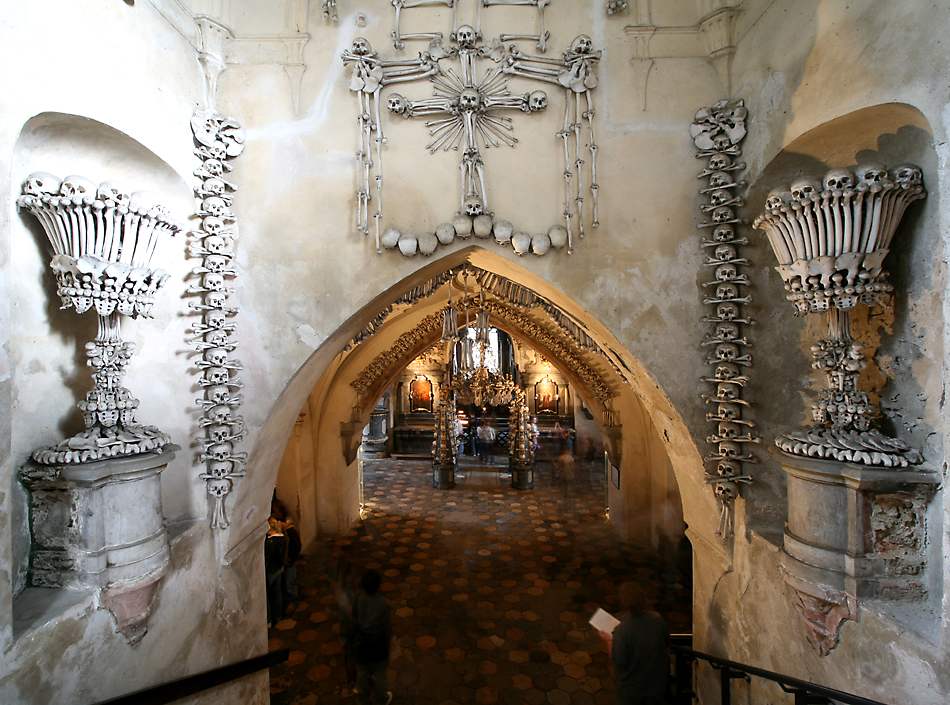
Location #5: The Sedlec Ossuary

My, it's been a while since I've updated! Graduating will do that to you, my apologies. Allow me to make it up to you by presenting another creepy location! The Sedlec Ossuary!

Oh, this is going to be good...


Now, there are a couple churches like this one that are built out of bones. Back in the late 16th, 17th and 18th centuries, bodies piled up too quickly for churches to dispose of in a timely manner. So what was their solution? Mass grave? Don't be ridiculous! No, these pious people of the cloth decided to follow the oh so important rule of waste not, want not!

As I said, there are more churches than you would think that are built out of bones, but this one holds a bit more of a creep factor for me than the others. I think it may be the elaborate chandeliers, and the coat of arms built entirely out of bone.


  Yes, that is exactly what should be on every church's front door...


The Sedlec Ossuary is located in the small Czech town of Sedlec. A small abbot located in the town was blessed with soil from the Holy Land on the cemetery in the 13th century, and suddenly, people from all over Europe were demanding to be buried there. The Sedlec graveyard grew by leaps and bounds until 1870, when they were unable to keep up with the amount of bodies being shipped in, and the priests decided to finally do something with the decaying bodies laying about. They hired Czech woodcarver Frantisek Rint to create something both fascinating and terrifying in one quick glance.

No, I insist.... after you....

Today, this chapel is infamous for the extravagant decor made from human remains, and some claim that it was what inspired the few other houses of God to try out a new decorating scheme. It was even inspiration for Dr. Satan's lair in the Rob Zombie movie House of 1000 Corpses.

April 26, 2012

Location #4: Waverly Hills Sanitorium

My next creepy location is one that breaks my heart as much as it freaks me out. This place is probably rather well known, being on at least two ghost hunting shows, but that does not make it any less deserving of a spot on this list.


Waverly Hills Sanitorium is a hospital built in Louisville, Kentucky to help battle the white plague, or tuberculosis illness. Built in 1910, it was originally intended to house 40 to 50 patients, a modest two story hospital with the standard equipment.

The ravaging outbreak of TB resulted in Waverly not only being remade into a multistory building capable of housing 400 patients at once, but also granted it the dubious honor of being the epicenter of study, doctors working around the clock to try and find a cure.


The mass amounts of patients that flooded Waverly never caused a crowding issue, as the deaths were rampant. There was no cure for TB yet, and Waverly became the center for figuring out a cure. As a result of this decision, many experimental treatments were attempted.

Surgery to remove ribs and lungs, sandbags crushing the chest to try and deflate the lungs, and even electroshock therapy were all attempted as cures, and proved just as lethal as the white plague itself. As antibiotics had not been discovered when Waverly opened, treatment consisted of heat lamps, fresh air, high spirits, and reassurances of an eventual full recovery. Once tuberculosis hit its peak, deaths were occurring about one every other day.


The patients were not the only ones at risk. Room 502 is sadly infamous for workers coming in one day to discover a nurse having hung herself in front of it. The woman had contracted TB, and had also discovered she was pregnant. Being unwed, and sick with TB, knowing her child would have it too, she saw no other way out, and these days is seen roaming the halls of the wing she worked in.


The hospital closed in 1961, having the highest deathrate in the entire country, and an entire wing dedicated to the morgue in order to deal with said deaths. The patients never knew about the large amount of deaths, however, as the doctors used a 500 foot tunnel known as the Body Chute that traveled to the bottom of the hill the hospital was built on to transport patients who died to keep morale up.


Today, Waverly can be toured overnight for a hundred dollars a person, with a Halloween haunted house attraction used to fund restoration of the building. Full body apparitions, doors slamming, hair pulling, flickering lights, and heart wrenching EVPs are just a handful of the activity that goes on when the sun sets on Waverly Hills Sanitorium.


February 16, 2012

Location #3: Isla de las Munecas

Those of you with a phobia for dolls are not going to like this next location I have chosen. Consider yourself warned.


No, this isn't a creative shot of that one stray doll someone always finds in a creepy location.


The entire forsaken island is covered in broken, rotted, decapitated old dolls. Hence it's name, 'Island of the Dolls'

Isla de las Munecas started out with good intentions, as many creepy places do. The island’s only occupant, Don Julian Santana, found the body of a drowned girl in the canals of Xochimico near Mexico City some 50 years ago. He was heartbroken and disturbed by her death, so when he founda doll floating by in the canal soon after, thinking it was hers, he placed it in a tree to please the girl's spirit, and to hopefully shield the island from being haunted by her or any other vengeful souls.


As what usually happens to those who live alone, Santana soon developed an obsession. Convinced one doll in a tree was not enough, he continued to snatch up any dolls, or doll parts, that floated past in the canal, and hang them somewhere on the island. It soon became less about the girl, and more about easing his own tortured soul, and he began wandering from home to tear through trash for more parts, and even started trading his home grown crops for dolls.


Man, it's..... it's good I'm not freaked out by dolls, or.... or this would get hard to write...


*clears throat* Anyway... The tale becomes even more depressing in 2001 when Don Julian drowned in the same canal as the little girl did. People said that the dolls, possessed by tortured spirits, murdered the old man out of fury for him gathering such a collection. A far more likely story is that Santana’s death was an accident... even though he'd lived there for so many years and was a talented swimmer...


Getting to the island is laborious and exhausting, but witnessing all the dolls and the disturbing manner they now all hang is an incredible sight. The majority of the dolls were given up by their previous owners due to being worn out and broken, which made Santana pity the poor toys all the more. Now, they hang from trees, fences, buildings and wires, serving as homes for insects and spiders, and creeping the ever loving hell out of visitors, who often choose to leave their own dolls, thereby carrying on Santana's work, long after his death, and perhaps easing his own tortured soul in the process.


Alright, I get it, lots of messed up creepy dolls. I'm out.

The Dullahan

The next beastie on this list comes from the Emerald Isles, lovely Ireland!


With many similarities to the Headless Horseman, the Irish Dullahan is a kind of unseelie fairy. This is no Tinkerbell, though. The Dullahan is a figure of death, a headless creature riding a huge black horse, which is sometimes also headless, with the dullahan's own head carried protectively under its arm.

The eyes are massive and bloodshot, moving constantly in an attempt to locate the unfortunate soul it's been sent to collect. The flesh is a feted green, and sags loosely from the skull.

Sometimes the dullahan drives a funeral coach, decked with candles supported by skulls, wheel spokes made from thigh bones and a wagon covering made from a stretched dried skin.

When this fairy stops riding, it is apparently where a person is supposed to die. Once stopped, the dullahan's cracked lips will part and call out the victim's name, causing said person to drop dead.

It's impossible to lock out a dullahan. Locks and gates of all manner and design open without being touched as they approach. And if you are unfortunate to come across one at night, and you are not its intended victim, keep your eyes firmly averted and do not speak to it. The Dullahan despises being watched while working, and if witnessed, they will dump a tub of blood onto you, marking you as the next to die. Or, if you are fortunate, they'll merely blind you with the whip they carry, fashioned from a human spine.

The only known way to drive away a dullahan is with a bit of gold, be it a coin or a pin. This is not proven to work for those meant to die, however, so... just stay in at night when visiting Ireland.

And as always, if any of you have tales or experiences of your own involving any of these beasties, please post said stories on the monsters' respective pages!!

Woman in White


Women in White are seen all over the world, and often go by other names, White Lady, White Widows, and even La Llorona, Mexico's Weeping Woman. There are as many variations on how the lady died and what she wants as there are names for her.

A rare variation of the Woman in White is a beautiful woman who, due to insanity over being betrayed by a husband or lover, kills her children, most often through drowning. When she realizes what it is she has done, she kills herself out of grief and madness. Now, she prowls the world, seeking her lost children and punishing unfaithful men.

The more popular versions of White Ladies tells of brides killed on or shortly before their wedding days, but these ghosts are usually benevolent, the bride often simply seeking her groom, or wishing for a ride to her wedding.

Mexico's La Llorona tells of a woman killing her children by drowning them, in order to be with the man that she loved. He of course rejects her, and she kills herself. Challenged at the gates of heaven as to the whereabouts of her children, she is refused entry until she finds them. The woman is forced to wander the Earth for all eternity, searching in vain for her drowned offspring, with her constant weeping giving her the name "La Llorona".

All in all, Women in White are more saddening and heartbreaking than creepy, but still deserve a place here, I feel.

And as always, if any of you have tales or experiences of your own involving any of these beasties, please post said stories on the monsters' respective pages!!

Location #2: Pripyat


Oooh, yes, Pripyat, you definitely have a place on my Creepy Places list.


 Pripyat was founded in 1970 to house workers for the Chernobyl Nuclear Power Plant, but was abandoned in 1986 following the Chernobyl disaster. Said disaster being when there was a small malfunction in the Chernobyl reactor, so for safety reasons the city was evacuated. The 'small malfunction' led to an explosion at Reactor 4.


People flooded to this bridge to watch the reactor, seeing a blast of colorful flames shoot up past the very top of the smoke stack. Every person who stood on that bridge died shortly after, having received over 500 roentgens of radiations, which is fatal.


The rest of the town was flooded with powerful waves of radiation, so strong that the entire population of 50, 000 was evacuated, requiring people from the Soviet Union to be FORCED to come and help evacuate people and calm the danger in the plant. Most of said people also died from the radiation.

The funfair built in Pripyat was to be opened on May 1st. The Chernobyl disaster occurred on April 26th, leaving the fair completely abandoned. The ferris wheel remains one of the most irradiated parts of Pripyat since the disaster, making it still dangerous today.


The hospital that took in many of Reactor 4′s first victims for treatment was already exposed to huge amounts of radiation, rendering any attempts to save people useless.


The looming ferris wheel of Pripyat, as well as many broken buildings, inspired a creepy level in Call of Duty. Honestly, it just inspires me to find a fairground that's not creepy as all hell.